Archive for February, 2011

We’ve just announced our new Housing Market Seminar, Understanding Today’s Housing Market, 1Q11, being offered through our affiliate MillerQA. In the first part of the program my partner, Jonathan Miller, renowned real estate talking head, will be discussing the latest stats from the first quarter, both nationally and locally. Jonathan is expert at taking all the numbers bombarded at us throughout the day and putting them in context; whenever I hear Jonathan give one of his housing talks the light bulb always goes off!

In the second half of the program Jonathan will interview Barry Ritholtz, economist, media pundit, author and blogger. Barry is author of “Bailout Nation”, one of the best books I’ve reading on the financial meltdown of 2008, and the engine behind the well-known blog, The Big Picture. He is a dynamic speaker. (If you’d like to listen to Jonathan’s recent podcast with Barry click here and go to the archives.)

The program will be held on Monday April 4, 2011 at Scandinavia House, 58 Park Avenue (at 38th Street) from 4:00 pm to 7:15 pm. Approval is pending for 3.0 hours of CE credit for real estate brokers and agents (though the program is geared to and attended by a wide variety of professionals, as well as interested buyers and sellers.) To register, go to the MillerQA web site. Price is $145 per person, with an early registration discounted rate of $99 per person through March 7.

Jonathan Miller:Jonathan

by Marc Kushner, The Informed Appraiser

“The best way to realize the pleasure of feeling rich is to live in a smaller house than your means would entitle you to have.” -Edward Clarke

Over the past few weeks, there have been several news stories published on the the topic of shrinking office sizes. One good example is this CNN article. The gist of it is that on average, employee spaces have been getting smaller over the past two decades. According to International Facility Management Association, in 1994, the average office worker had 90 square feet of office space, but the area had been whittled down to 75 square feet in 2010. (Interestingly, executive management spaces have actually increased in size over this same period.) I suppose there is a limit to how small cubicles and offices can become, given that people are not getting any smaller. But the trend toward smaller offices may well continue into the next decade.

What are the implications for commercial real estate? For one thing, this will likely put downward pressure on the growth in demand for office space. If office employment increases by 5% while average office space per employee declines by 5% over the same period, there would be zero net gain in office demand. Existing office buildings that are designed with larger offices may experience functional obsolescence, and owners may eventually need to redesign existing spaces around smaller offices in order to remain competitive. The increasing prevalence of telecommuting may also make office location a less significant factor that it has been historically.

by James Dunne - The CREative Department

The sales history of this commercial office building is really the epitome of what has taken place during the past few years in the commercial real estate market, and the story behind the recent transactions are filled with such irony, that I had to write about it.

Back in 2007 the Mortgage Bankers Association (MBA) decided to purchase a building under construction at 1331 L Street NW in Washington DC for $79 Million, five blocks from the capital (makes sense because their political action committee, the Mortgage Bankers Association Political Action Committee or MORPAC, could be close to Congress to lobby them on behalf of their business). Holliday Fenoglio Fowler LP, a real estate advisory firm, announced in June 2008 that it had arranged the $75 million financing for the MBA at the height of the commercial real estate market MBA took out a $75 Million mortgage on the building from PNC.

Guess what happened next? The property market crashed. The value of the MBA’s shiny new office building plunged in value. In February of 2009, at the bottom of the market, the MBA sold the building for $41.3 Million, and essentially walked away from the balance they owed.

Now it’s time for the hypocrisy - John Courson, the CEO of the trade group, when asked in a prior interview about homebuyers intentionally walking away from their mortgages, said “What about the message they will send to their family and their kids and their friends?” On top of that, giant commercial landlord Tishman Speyer is locked in a court battle with the MBA, contending the trade group still owes $1 million after breaking an earlier lease to move into its former, massively overpriced headquarters.

However, the winners of this deal are also connected to the real estate industry - the buyer was the CoStar Group Inc., the largest provider of Commercial Real Estate Data in the U.S. (we use them in my office) - as mentioned, they paid $41.3 Million. But now, the commercial property market is rebounding (in my office we’re seeing strong demand from institutional buyers for high-quality, class-A, well-leased offices). So now CoStar is reselling the property, just a year later for $101 Million to German property-fund Manager GLL Real Estate Partners, who CEO Jochen Schnier is taking advantage of low interest rate. CoStar will stay as a tenant in the building. CoStar doubles its money, and GLL gets a high-quality, long-term investment.

“If people are informed they will do the right thing. It’s when they are not informed that they become hostages to prejudice.” Charlayne Hunter-Gault

For this post, I’m going to put in a brief word about my pet project, InformedAppraiser.com.

It goes without saying that the internet has changed the way appraisers work. Virtually all of the information an appraiser could possibly need can now be obtained via online sources. This is a good thing, of course. The flip side is that the old problem of “too little information” has been replaced with a new version - “too much information”.

Several years ago, I found my Favorites list (actually, Bookmarks list, since I use Firefox) growing too big for its own good. It got to the point where I’d have to scroll through hundreds of links to find what I wanted in any particular situation. Various attempts at organizing my Bookmarks proved fruitless. I figured that I couldn’t be the only appraiser facing this annoyance, and that there had to be a better way.

To that end, I developed InformedAppraiser.com. This website is essentially a database of websites that are of interest to appraisers. You simply select the type of information or resource you need, specify the location (if relevant), and presto - you are presented with a detailed list of links to websites that should be relevant to your interests. Best of all, I designed the site so that anyone can submit additional websites to the database with relative ease, a la Wikipedia. Users can also post comments regarding any website in the database to share their thoughts and insights with fellow appraisers. To top it all off, it’s 100% free (hey, it works for Google, right?).

Until next time, happy appraising, and stay informed!

I heard on the radio that a major home builder (sorry, didn’t catch which one) was planning to market new homes by including a energy expense guideline on all its new homes. The rating would be similar to the energy efficiency rating that comes with your new major appliance; the intent would be to educate the homebuyer on the lower monthly cost of utilities in one of their new homes as opposed to a lower priced but more inefficient older home.

When it comes to utilities costs we’ve noticed this lack of sophistication in our appraisal practice. Many small new rental developments in Brooklyn have recently been constructed with individual heating units so that the tenants pay for all of their own utilities. One building we recently looked at even submetered the water bill for their residential tenants. However, the rents in these buildings typically aren’t any lower than rents in buildings where utilities are included. The explanation that has been offered by landlords: Tenants don’t pay attention to that when signing a lease. With the cost of fuel typically in the $1.50 per square foot range, this results in an extra cost of nearly $100 per month to the tenant. With some of these new buildings also receiving tax exemptions, this results in a nearly net apartment building operation, but that’s a topic for a future post.

In the January 26 issue of Real Estate Weekly, Massey Knakal reported that total sales volume in 2010 was $14.5 billion “up 131% from 2009, when volume ended up at $6.3 billion.” In Eastern Consolidated’s January newsletter, they report that “the cumulative sales volume for the year ($15.8 billion) surpassed the total volume for all of 2009 ($5.9 billion) by 168%..” So, Massey Knakal reports $14.5 billion in 2010 sales and Easter Consolidated reports $15.8 billion…my question is, what accounts for the $1.3 billion difference, or nearly a 10% spread?

Both brokerages are relatively consistent in their estimates of 2009 sales volume ($6.3 billion reported by Massey Knakal versus $5.9 billion reported by Eastern Consolidated, a 7% difference), and both firms have similar estimates of sales during the peak year 2007 ($62 billion and $63 billion, respectively, a 2% difference).

With 111 Eighth selling for $1.8 billion I suppose that all it takes is one transaction to account for such a difference. Any thoughts?

By Marc Kushner, The Informed Appraiser

“Complacency is a state of mind that exists only in retrospective: it has to be shattered before being ascertained.” -Vladimir Nabokov (1899–1977), Russian-born U.S. novelist, poet.

Retrospective valuation assignments typically pertain to property tax matters, estate or inheritance tax matters, condemnation proceeding, suits to recover damages, and similar situations. The average appraiser will encounter these situations from time to time, but typical run-of-the-mill assignments are performed on a “current market value” basis with no retrospective element. However, a careful reading of USPAP indicates that the vast majority of appraisal reports produced by appraisers on a regular basis actually qualify as retrospective valuations.

Per Standards Rule 2-2 (a/b/c) (vi), every report must “state the effective date of the appraisal and the date of the report”. The Comment to this rule states:

“The effective date of the appraisal establishes the context for the value opinion, while the date of the report indicates whether the perspective of the appraiser on the market and property as of the effective date of the appraisal was prospective, current, or retrospective.”

Statement on Appraisal Standards No. 3 (SMT-3) states, in part:

“Retrospective appraisal (effective date of the appraisal prior to the date of the report) may be required for….and similar situations. Current appraisals occur when the effective date of the appraisal is contemporaneous with the date of the report.”

Got that? The only time you have a current appraisal is when the report date and valuation date are one and the same. Most appraisers I know tend to use the inspection date as the valuation date. The inspection typically takes place prior to the date of the appraisal report. Consequently, the valuation date is usually earlier than the report date. In theory - according to USPAP, that is - this common scenario qualifies as a retrospective valuation, and should be treated accordingly.

Now I ask, do you know anyone who actually does this?

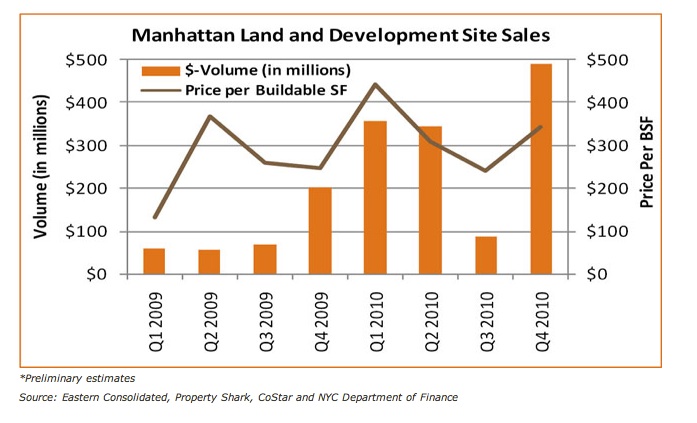
In its January 2011 newsletter of Manhattan Economic Indicators, Eastern Consolidated reviews the 2010 investment sales market by property type. Though packed with great data to provide a snapshot of the overall market, what jumped out t me was the upward trend for development site sales since the beginning of 2009. The market for Manhattan development sites was essentially paralyzed following the Lehman collapse in 2008. With no construction financing available and the condo market in a free fall, the bid-ask gap in land pricing was so wide that only a handful of sales took place in 2009, the majority of those to users. However, as Eastern Consolidated illustrates in their table, the trend began to reverse itself in 2010, with a notable upward trend in the volume of Manhattan land sales.

eastcon land sales

Seems that there is once again a market for land and developers are positioning themselves to get back to work. A textbook case of the real estate cycle in motion.

By Marc Kushner, The Informed Appraiser

“Letters are like wine; if they are sound they ripen with keeping. A man should lay down letters as he does a cellar of wine.” – Samuel Butler (1835–1902), British author

This being my first blog post here on Commercial Grade, I think it is appropriate to start at the bottom. Hence, this entry will touch on some issues regarding basements and cellars. I know, I know – you can hardly contain your excitement at this point. So please go ahead and read on.

(A brief comment regarding my chosen moniker, “The Informed Appraiser”: While this title might appear to be nothing more than a cheesy and conceited attempt at self-promotion, it’s actually also a shameless plug for my own website of the same name. But I’ll leave that topic for another blog post.)

In common use, the terms “basement” and “cellar” are usually bandied about interchangeably with fairly reckless abandon. To be fair, most any thesaurus will show the two terms to be synonymous. Here are their definitions, per the Random House Dictionary:

base·ment

/ˈbeɪsmənt/ –noun

1. a story of a building, partly or wholly underground.

2. (in classical and renaissance architecture) the portion of a building beneath the principal story, treated as a single compositional unit.

3. the lowermost portion of a structure.

4. the substructure of a columnar or arched construction.

cel·lar

–noun

1. a room, or set of rooms, for the storage of food, fuel, etc., wholly or partly underground and usually beneath a building.

2. an underground room or story.

3. wine cellar.

Close enough, right? For most people, perhaps. (All things being equal, “basement” has the advantage of avoiding the potential for confusing “cellar” with “seller”.) However, as appraisers we must hold ourselves to a higher standard. For those of us lucky enough to be working in NYC, the Department of City Planning’s Zoning Resolution could be taken as that standard. Weighing in at 3,349 pages, this voluminous tome sets the tone for the development and use of real estate in NYC. Take a moment to peruse it and you will see that “basement” and “cellar” have very specific definitions.

In short, the Z.R. defines a basement as “a story partly below curb level, with at least one-half of its height (measured from floor to ceiling) above curb level.” A cellar, on the other hand, is defined as “a space wholly or partly below curb level, with more than one-half its height (measured from floor to ceiling) below curb level.”

This is not merely a matter of semantics. The above distinction carries with it legal and practical implications in terms of permissible uses, construction requirements, and the like. Perhaps the point most significant for appraisers is that Zoning Resolution’s definition of Floor Area specifically includes basements, but excludes cellars (with the noteworthy exception of cellars that are used for “dwelling purposes”). Because floor area is typically the most fundamental building metric used by appraisers, it is vitally important to know precisely what any particular building’s floor area includes – or should include.

To further complicate matters, the NYC Department of Buildings as well as the Department of Finance – whose building records are often referenced as the source for building floor area measurements – do not always follow this rule consistently. (This is apart from the general observation that published floor areas can be inaccurate in virtually any case due to a variety of reasons, even where there are no basement/cellar issues at play.) In my experience, basements are sometimes excluded from recorded floor areas, while in other cases cellars may be included. Consequently, two buildings with identical published floor areas may in fact not be the same size at all. Conversely, two buildings with appreciably different recorded floor areas may actually be the same size.

In light of the above, I tend to proceed with caution when utilizing published building floor areas, particularly where basements and/or cellars are involved. To ensure consistency, care should be taken to consider exactly what is being included in the floor area measurements for both the subject and any comparables being analyzed. Otherwise, flawed comparisons and conclusions may result.

by The Affordable Oracle

We hear it all the time, that a transaction was done “off-market”. Many real estate funds indicate that they will add value by seeking deal flow through “quiet” or “off-market” channels. As appraisers we are often told by buyers that they secured a transaction “off-market” and so it was bought below market price. But what are the reasons that transactions get done in such a fashion, after all the knee jerk reaction is that a market sale will undoubtedly procure the highest proceeds for the seller. I will begin the list and hopefully others can contribute their insight as to reasons why transactions get done “off-market”.

1. Some real estate requires extensive due diligence to arrive at a bid and so prospective buyers are hesitant to spend money pursuing a transaction knowing they are one of a large pool of bidders. So an offering to only a handful of qualified buyers will assure bidders that their pursuit costs are justifiable.

2. A situation where a property has one or two logical buyers a seller can solicit negotiations with those entities directly and possibly negotiate a lower brokerage commission

An excellent example of this is a conduit air right lot, in other words a lot that prevents 10-foot continuity necessary for the transfer of air rights in New York City.

  • Categories

  • Tags