The CREative Department


From James Dunne in The CREative Department

Want to be on the 90th Floor of One57? You’ll have to pay $90 Million. I happen to be jogging through Central Park and noticed that the construction appeared to have topped off – according to the Commercial Observer today, it has. Here’s the shot I took; One57 towers above all the surrounding buildings:

ONe 57 from CP

Gary Barnett of Extell Development announced back in May that an unnamed billionaire was in contract to purchase a penthouse unit for $90+ Million. Here is a picture of the views from the One57 website:

CP view one 57

While much uncertainty remains in the housing market across the U.S., including NYC, the luxury market continues to break records. Extell reports they have $1 Billion worth of units in contract at One57. However, the penthouse sale represents the very top of the luxury market, and as Jonathan Miller estimates, a view of Central Park can add 25% to an apartments price, plus there is a 9% premium in NYC for condo vs. a co-op. This adds up to 34% premium to be in the newest luxury condo building with views of Central Park.

by James Dunne - The CREative Department

As a kid visiting NYC in the 80’s, I was always fascinated by the graffiti covering subway cars and buildings. However, by the time I moved here as a young adult in 2001, the city had been cleaned up. I was on Davis Street in LIC this morning, and happened upon one of the last graffiti-covered blocks I know of. As LIC has now been as part of the Hunters Point Subdistrict Rezoning, these buildings (in their current form) may not be around for much longer:

Unknown

Unknown-1

Unknown-2

By James Dunne - The CREative Department

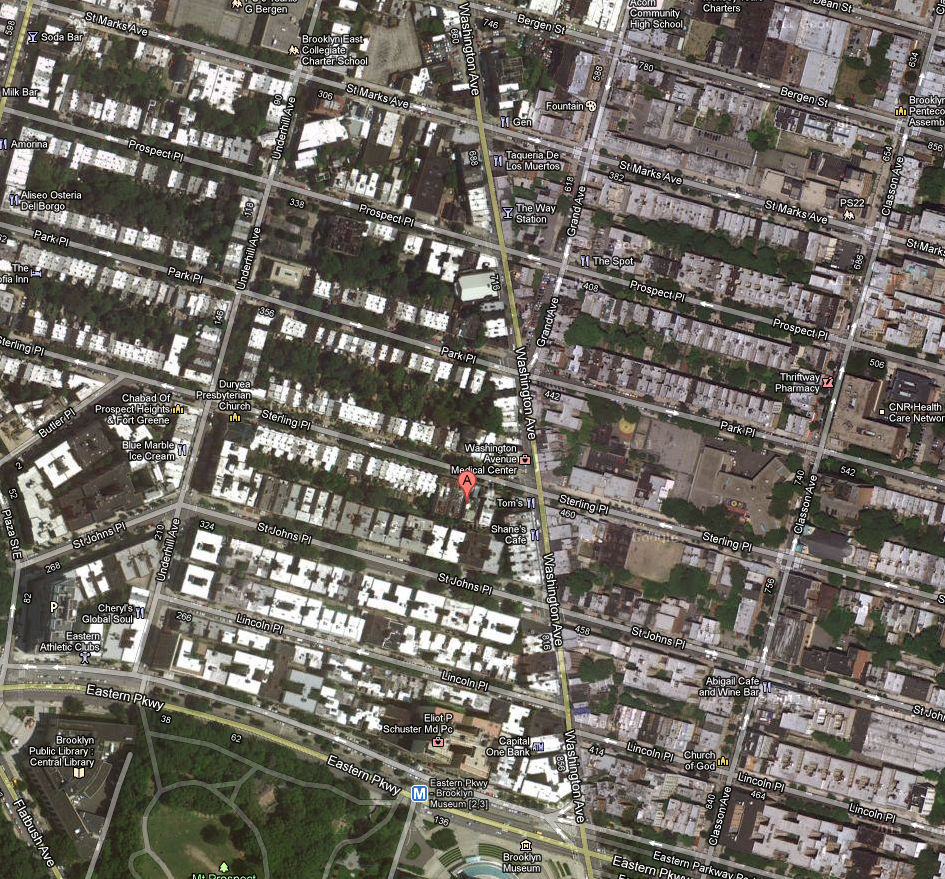
I’ve been working on project in Prospect Heights, Brooklyn, a neighborhood just north of Prospect Park, which has become greatly gentrified over the past decade. Many of the buildings in Prospect Heights are under cooperative ownership. Washington Avenue, which runs diagonal through the photo below, is the traditional boundary between Prospect Heights on the west side and the neighboring Crown Heights neighborhood to the east. The stark contrast of the revitalization of Prospect Heights is apparent by the building roofs: on the Prospect Heights side most roofs are covered in fresh “silver coat” (aluminum-based reflective material to keep energy-costs down in the summer), whereas on the east side of Washington Avenue, Crown Heights, the roofs are clearly not as well maintained.

Areal Photo

By James Dunne - The CREative Department

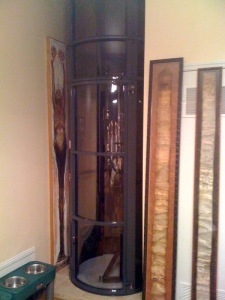
We live in a vertical city. Elevators shuttle us to our offices and apartment. However, much of NYC’s housing-stock still consists of walk-up brownstones, and while most are just 3 to 5 stories, for the elderly or anyone that has trouble climbing stairs, this poses a problem, but to install a traditional elevator in a brownstone, if it’s even feasible, will typically run from around $120,000 to $150,000 for the equipment, labor and typical work required on the house, on top of this.

Enter the pneumatic elevator. They take up less than half the space of the smallest of traditional elevators, and cost a fraction of the price. Typically around $30,000 to $35,000. Pneumatic or tube elevators work by creating a vacuum, which sucks the cylinder car up to the floors. I took a ride in one, and they work great. Despite being widely available around the US, these are not yet approved for use in the five boroughs, however, I’ve heard that the NYC Buildings Department may soon be approving them. Overall, they’re a practical and cost effective alternative to a traditional elevator for smaller buildings.

elevator1

Photo by James Dunne - The CREative Department

This is a picture of a newly constructed building on 9th Ave in the Clinton neighborhood of Manhattan:

9th Ave Building

I couldn’t resist posting this.

Use a forklift of course.

It’s common practice that NYC parking garages in high-trafficked areas of Manhattan routinely fill their garages up to double their stated maximum capacity during the day. In fact, this is usually the only way the operators can turn a profit. Typically, the garage operator rents the garage from a building owner, and usually the rates charged for the monthly fees for the “official” spots will only allow the operators to cover their rent. Profit comes from every extra car they can squeeze into the garage during the day.

I was inspecting a building recently, and asked how this Smart Car got into this spot (there’s literally an inch on each side). Without batting an eye, the operator told me “with a fork-lift of course.”

by James Dunne - The CREative Department

I’m thinking about buying the Empire State building. I like Art Deco. And after recent renovations to make it more energy efficient, the 2.9 million square-foot building is now an LEED-Certified (green) building. Also, I want to be able to hang out on the observation deck whenever I feel like it.

Malkin Holdings announced that they plan to convert the Empire State Realty Trust into a publicly traded REIT trading on the NYSE, with the ticker ESB. Bloomberg reported that according to the IPO filings, the REIT will consist of roughly 7.7 million square feet across 12 buildings. However, the Empire State Building will be the primary holding in the REIT.

The 102-story building has had a number of battles in recent years with the Malkin’s fending off Trump and the now deceased Leona Helmsley for control, but with recent renovations and capital improvements, the iconic building is now positioned as a solid B+ office building, and thus has been attracting new quality credit tenants.

The REIT plans to raise $1 billion the IPO. The share prices have not been announced, and I haven’t seen the historical income or projections, however, high-quality well-leased commercial real estate, especially in NYC, has been one of the bright spots in our economy. For 2011 the FTSE NAREIT All Equity REIT index was up 8.28%, that’s almost four time the S&P 500 return of 2.11% return for 2011. This, with the chance to say I own a piece of the Empire State building, has put the ESB REIT on my watch list.

from James Dunne - The CREative Department

I recently performed a valuation on a multi-building office complex in Brooklyn that will be installing a new cogeneration energy system to replace the complex’s current boilers, while supplementing its electricity usage. This is the second such property in Brooklyn I’ve appraised in the last year that has installed or will install a co-gen system to power its buildings.

Cogeneration is system that creates heat and generates electricity through the burning of natural gas along with the recirculation of excess heat in a system. Typically, the use of microturbines or reciprocating engines generates the electricity through the combustion of natural gas, plus the system can also drive the chillers for a large HVAC unit.

Initial capital costs for a cogen system can be significant. In the complex I recently looked at, capital costs would be roughly $2.8 million for removal of the old boilers and replacement of old equipment with the new system; however, with cost savings of roughly $500,000 per year, or between a 53% to 58% savings in energy costs, the payback would occur in about 5.5 years. With a life expectancy of over 20 years, substantial savings would occur over the long run.

What was more interesting was that a bank was willing to fund this capital cost, with no up front capital outlay from the building owners. Even with the financing payments, there was still a significant net savings. The cost was further brought down by a NYSERDA (New York State Energy Research and Development Authority) grant to cover a portion of the capital costs.

With increases in taxes, labor costs, materials, and energy costs in recent years, building owners in NYC should explore cogeneration. It will benefit the environment, and the bottom line.

Additional note: NYU upgraded to a new gas-fired cogen system at it’s main campus last year. There’s a lot of good info on the system and cogeneration here.

by James Dunne - The CREative Department

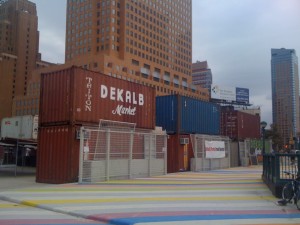
I recently paid a visit to the new DeKalb Market in Downtown Brooklyn. DeKalb Market is temporary market place located on the future CityPoint development site located on the corner of Flatbush Avenue and Fleet Street (one block south of DeKalb Avenue). The market has a variety of boutique shops and food vendors situated in metal shipping containers. With about 20 stores, it’s open seven days a week, but most vendors are only there on the weekends.

Utilizing shipping containers for purposes other then shipping goods is a practice that was once only associated with third-world countries, where old containers were out-fitted to serve as housing, or often shipping containers were brought into natural disaster areas to serves as temporary housing or disaster relief command centers.

JD1

However, in recent years I’ve noticed a surge in the popularity of shipping container use - it seems to have become a trend with architects and designers to tinker and work creatively with the containers. There have been large houses created from combining the containers, with the results barely resembling the original containers.

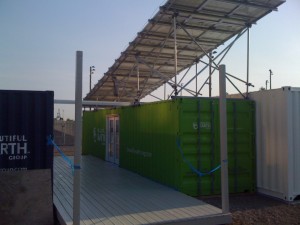
The photo below is an office that runs on solar panels that I spotted at the new Brooklyn Bridge Park.

JD2

NYC is an ever-changing landscape. Big projects such as CityPoint often take years to get off the ground, and are typically constructed in stages. A temporary market place constructed of shipping containers is a great interim use. With new and creative shipping container uses popping up all over, I think this shipping container trend, whether in the third-world or the developed world, is here to stay.

by James Dunne - The CREative Department

I recently returned from a vacation in Ireland. I was in Dublin for my sister’s wedding, then I took some time hiking on the West Coast with my brothers. The last time I was in Ireland, 5 years ago, the Celtic Tiger was roaring, and everyone was driving around in SL600’s and owned vacation homes on the Spanish coast, now there’s over 14% unemployment in the country and over 300,000 homes sit vacant.

Ireland is in a tough spot. The previous government’s (Fianna Fail) perilous decision to cover all bank assets (not only deposits, but bonds and debt) during the onset of the financial crisis has put the country severely into debt, resulted in a joint EU-IMF bailout of the country in November of 2010. The government has had to drastically cut services and public sector wages and raise taxes, further hampering a recover. Most major banks at this point have essentially been nationalized, including AIB, Anglo-Irish, Irish Nationwide and EBS. Furthermore, a recent stress-test found further capital shortfalls in the banks, with more capital injections likely being needed.

There will be no luck for the Irish economy, but there are sectors that are doing well. There was 1.3% increase in GDP in 1Q2011, due largely to exports, which are booming; however, domestic consumption is still down. Looking at GNP, which excludes Irish-based multinationals, it was down 4.3% from the prior quarter; overall, GDP is off 18% from peak. Tourism appears to be doing ok – it’s anecdotal, but every place I went was mobbed by tourists, and the hotel where my sister was staying was completely booked up. Google recently purchased the largest office building in Dublin, a sign of a long-term commitment to the country, and other tech firms and pharmaceutical companies have announced than plan to increase hiring in coming months.

The country will probably see a slow improvement in the economy over time if the ECB keeps interest rates low (many mortgages in Ireland variable and are tied to ECB rates), and if the IMF extends extra credit to the country if it is needed. However, the real thorn in the side of the Emerald Isle is the remains of its housing bubble. A recent report by the Urban Environment Project at University College Dublin (UCD) puts the number of vacant homes in the country at 345,000 or 17%, of the housing stock. This is even higher than the report by the National Institute of Regional and Spatial Analysis figure of 300,000. Some of these homes may be vacation homes, but regardless, in a country of 4.4 million people, it will take years, if not decades to clear this inventory.

While on average, real estate prices have fallen by over 50% nationwide, land values have dropped by 75% or more. Near the peak of the bubble, a disproportionate amount of loans, in terms of euro-value, were given out to just a handful of developers; now NAMA, the organization created to handle the distressed assets, is forced to dispose of this land at a massive loss. The average Irish citizen will be paying for this mania for decades though increased taxes, and lower wages. As one of my uncles who has had to close one of his two cafes put it, “the many are having to pay for the sins of the few.”


Irish Coast

Next Page »

  • Categories

  • Tags