Archive for May, 2010

by James Dunne - The CREative Department

I thought I’d share an interesting construction tidbit: a close friend of mine works for a large real estate management company. Recently, at one of the buildings they manage, excavation work was being preformed in the cellar; however, the work had to be stopped, because they uncovered bones. There was a church directly across the street, so initially they though they may have hit an old graveyard. In cases where the unanticipated discovery of human remains occurs, the New York Police department must be contacted, in addition to the Medical Examiners office, as well as the Landmarks Preservation Committee (LPC). The basic procedure is as follows: the bones are sent to the Medical Examiners office, if the bones are determined to be less than 100 years old, then the property is considered a crime scene, in which case an investigation is opened. If the bones are determined to be more than 100 years old, the LPC contacts an archeologist to determine if there is any “historical significance” to the findings. While this is occurring, construction is stopped. If the site is determined to be of historical significance, an archeological team will be called in, which can significantly delay construction. In the end, the bones at the building that my friend’s company manages, turned out to be animal bones, and 24 hours later, they continued construction, and everyone took a sigh of relief.

by Gleb Lerman, the Affordable Oracle

I think most appraisers providing re-valuations on existing loans will have at least some curiosity as to what the outstanding loan amount on the subject property is. You will often hear chatter along the lines of “I just appraised an office building in Brooklyn worth $12,000,000 and XYZ Bank is owed $17,000,000…they are screwed!!!

The truth is there is more to a loan’s credit worthiness than the value of the underlying collateral. In fact, a policy statement by the FDIC on Prudent Commercial Real Estate Loan Workouts lists assessment of collateral value as the third of three steps a bank needs to take in evaluating a troubled loan. Here are just a couple of examples where LTV over 100% does not mean a bad loan for the bank.

The first step is analysis of the repayment capacity of the borrower:

  • A borrower who has a floating rate loan in today’s low interest rate environment is more than capable of keeping loans current even if the LTV exceeds 100%. Of course term risk, or risk associated with the inability to repay the loan upon maturity is a concern.
  • A user operating a successful business out of a property that they own is also very capable of making loan payments despite a high LTV.
  • A borrower who has sufficient income from other properties to cover the shortfall on a distressed property can represent a good loan so long as there are sufficient personal guarantees.

The second step requires an evaluation of guarantees:

  • Again, personal guarantees can play an important loan in evaluating the credit worthiness of a low LTV loan.
  • Of course the issue of guaranteed need to address the enforceability of such guarantees. A legal abstract of representing probabilistic guarantee enforcement is recommended. A borrower in distress can shield themselves from guarantee enforcement by hiding assets, or stalling through litigation.

Last, and probably least according to the FDIC is the assessment of collateral value.

  • Although last, this is perhaps the most complicated of the three requiring the highest level of subjective judgment.
  • The regulator’s policy statement states that asset evaluation (internal or external) must be performed for loans identified as potential workout candidates.
  • Bank examiners are directed to review appraisal values as well as the underlying methodology, and reasonableness of assumption and are instructed to direct the institution to clarify any weak or unsupported assumption.

To sum, while collateral value may not be the most important in evaluating a potentially troubled real estate loan it is the most complicated and should be conducted by qualified professionals with the necessary competency.

by Gleb Lerman, the Affordable Oracle

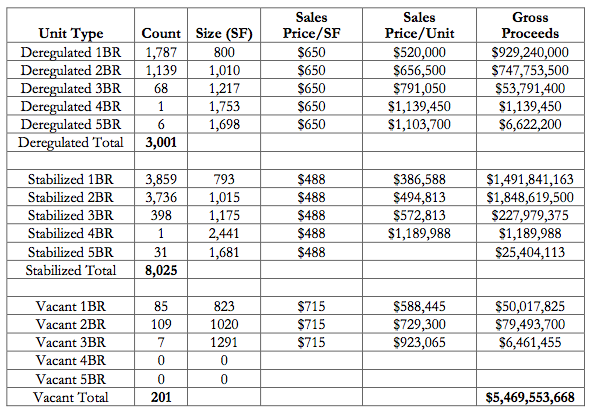
A couple of weeks ago after reading this article I decided to run a quick back of the envelope on feasibility of the Peter Cooper Village/Stuyvesant Town (PCV/ST) tenants to buy their complex. I dusted off some old offering documents dating back to 2006 and found a detailed unit mix for the complex. The first thing I wanted to see is what would happen if tenants were given the ability to buy their units at prices that are too good to pass up. Throwing some numbers around with some residential appraisers I put in a price of $650/SF for the unregulated tenants to buy their units and $488/SF for the rent stabilized tenants. The result of this crude analysis was intriguing. $5.5 Billion very close to the $5.4B paid for the complex in 2006.

chart

The next obvious question was how would the tenants find the money to buy their apartments. Residential mortgages of course!!! But this opened up a host of other questions:

What would the common charges be?

Can the unit be sold even cheaper, after all the complex is believed to be valued at $2-$3B.

Could the tenants afford to pay common charges and mortgage?

What would happen to the commercial component?

Who would issue so many residential mortgages?

Can the mortgages be packaged in to a RMBS?

Would the geographic concentration of this RMBS be appealing to investors/rating agencies?

Can a flip tax be used to aid in the stability of the complex?

Can the mortgages be negatively amortizing to aid tenants with limited incomes?

Can we throw some local and federal subsidies to aid in the feasibility?

Given lack of time I was unable to investigate all these questions, however I believe that once all the above questions flushed out the conclusion of the investigation will be that a condominium conversion for the sale of the units to existing tenants is feasible and will result in the highest return to the existing bond holders. The underlying success of this will lie in the ability to issue a RMBS backed by low LTV high LTC (Loan to Cost) negatively amortizing mortgages. I will continue working on this as I attempt to put together a white paper. Stay tuned.

An excellent article by Justin Davidson in New York Magazine called The Point of the Skyline gives a fresh perspective on the towers that we look at (and work in) every day around us. An excerpt:

A skyscraper is not a metaphor. It’s what happens when a team of cost analysts, insurers, engineers, architects, developers, investors and lenders makes a collective determination tht math, physics, and market forces, fused in one enormous hunk of a building, will probably yield a profit.

OK, so he forgot to mention the appraiser’s critical role, but regardless it is an interesting read. He makes the case that the controversial Tower Verre, designed by Jean Nouvel, for a small site next to MOMA on West 53rd Street should be built. Another excerpt,

We have a messy, malleable system for making decisions about the sklyine….Bold ideas are tossed into a cauldron of traffic studies, environmental-impact statements, community-board meetings, and landmark hearings, a broth that tends to boil good architecture down to a glutinous pulp.

See…and you thought that they were just buildings…

by Gleb Lerman, our Affordable Oracle

Land is often regarded as the most speculative and risky investment when it comes to real estate as an asset class. During normal times banks seldom lend more that 50% LTV and when they do lend they often charge an interest rate premium reflecting the credit risk associated with land.

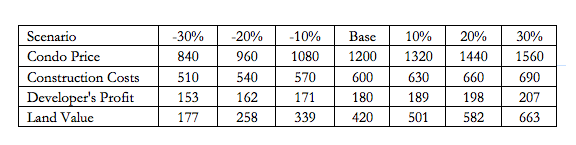
I would like to illustrate the volatility of land value using the most recent market cycle. Let’s say at the peak of the condo market a residentially zoned site was worth approximately $400/SF. The reason it was worth that much is because a developer would figure he can sell condos for $1,200/SF and it would cost him $600/SF to build (hard and soft costs) plus $200/SF in developer fees leaving him with $400 to spend on acquiring the land. Now if the prices of condos were to increase by 10% to $1,320 the developer would be able to pay 30% more ($520/SF) for the land. So all else being equal a 10% increase in condo pricing resulted in a 30% increase in land value. On the other hand, were condo prices to decrease by 10%, the value of the land would decline by 30%.

I know that this model is overly simplistic, but it nevertheless brings home the point that value of land is geometrically related to the value of land improved to its highest and best use.

This geometric relationship is tempered by several factors. The most obvious is the fact that construction costs often follow real estate values. Thus if prices decrease demand for new development decreases as well resulting in lower construction cost.

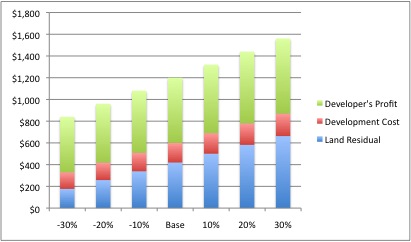
In the following graph I show how variations in condo prices affect the underlying land value. The construction costs (hard and soft) are assumed to move at half the rate of condo prices. In other words if condo prices increase by 10%, construction costs increase by 5%. Developer’s profit is equal to 30% of construction cost.

Chart

Graph 2

Other issues that should be accounted for in modeling this relationship should be.

  • Financing costs during expansions and contractions:
  • Absorption / lease-up periods during expansions and contractions.

by James Dunne - The CREative Department

One topic has been impossible to avoid in business news the past few weeks: the case against Goldman Sachs. Civil charges filed by the SEC, a grilling by the Senate’s Subcommittee on Investigations, and now a criminal investigation by the Justice Department. With all the opinions and analysis flying around out there, I felt the need to pitch my two-cents in.

Clearly, the senate hearings were just intended to be a public flogging, one that gave politicians a chance to scold the big money makers at Goldman while scoring some populist points with their constituencies. There was no smoking gun, nor was anyone really expecting anything material to arise out of the Senate hearing – that will be the job of the SEC, as they are alleging fraud, which from what I gather, they’re going to have a tough time proving. The case will boil down to disclosure, and if material information regarding the Abacus Synthetic was withheld.

To summarize the allegations, the SEC has filled civil charges claiming that Goldman did not disclose conditions surrounding the Abacus 2007-AC1 Synthetic to investors; specifically, it claims that Goldman failed to disclose that Paulson & Co. (a hedge fund) had a say in constructing the specific reference CDO that was used as the reference for the Abacus Synthetic. The SEC also claims that Goldman did not disclose to ACA (an independent third party that was selected to manage the security) that Paulson & Co. planned to short the Abacus Synthetic, but rather ACA was told that Paulson would take a long position on Abacus.

Unless you’re an investment professional this may all sound like a lot of financial mumbo-jumbo, so let me attempt to explain. The Abacus security in question is a “synthetic” CDO. A CDO, or collateralized debt obligation, is a portfolio of mortgages, which is typically sliced into traunches of varying risk for which bonds are issued at each risk level. A synthetic is a derivative- meaning it derives its value from another underlying product, in this case, a CDO, but ultimately hinges on the performance of sub-prime mortgages and whether or not the owners default on them. However, Synthetic CDOs, which Abacus was, are actually structured as a credit default swap (CDS), which is essentially insurance on something – in this case the insurance is on the performance of the sub-prime mortgages that make up the reference CDO. Confused yet?

The crux is that this product was synthetic, and because neither counter-party to the trade actually owned the reference securities, it was essentially a bet on the housing market- the investors taking the long position betting the market would continue to rise, and the short position betting the market would fall. The counter-parties to the trade were both taking a risk, and despite language from Goldman traders making “lemonade from big old lemons,” Goldman continues to maintain that the investors who took the long position (who lost large amount of money because the sub-prime mortgages defaulted), were intelligent and informed institutional investors, which it seems they were (ABN Amro & IKB Deutsche Indusriebank were the two largest institutions that lost money). Paulson & Co., who took the short position and bet that homeowners would default, made $1 Billion on the bet.

In April of 2007, when this deal was structured, the housing boom was still roaring – I should know, I was working as a real estate agent at the time to pay for my college expenses, and at that time investors were throwing money at anything with the words “real estate” attached to it, so I’m sure Goldman had no problem finding willing buyers to take the long position on Abacus. The opinion on the Street is that Goldman did not do anything legally wrong; however, there are ethical questions that are raised. Real estate agents in New York are bound by their fiduciary responsibility, meaning that they must work in an ethical manner and must only work in the best interest of their client or customer (either the seller or the buyer). Dual Agency is allowed, but only if it is disclosed to and agreed to by both parties in writing. Goldman is a market maker for securities, and under current securities laws they can advise both sides of the trade, and trade on their own account in the security. This is analogous to a real estate agent trying to look after the best interests of the buyer, the seller, and the best interests of him or herself. The problem here is not Goldman Sachs, but the current regulations that allow this to take place. While as a general rule, I’m in favor of less regulation, securities regulators should look at the real estate industry’s notion of fiduciary responsibility before any new laws are passed.
  • Categories

  • Tags