Archive for March, 2010

by Gleb Lerman, The Affordable Oracle

Yesterdays Crain’s article, Fannie Mae crimps Battery Park apartment sales, highlighted the fact that Fannie Mae has stopped buying loans for condo apartments located in Battery Park City. Fannie’s pullout is a result of resetting ground rents for the land on which these condominiums are built. For those of you who did not know, all of Battery Park City is owned by Battery Park City Authority (BPCA) and all private development in Battery Park City is conducted by ground leasing the land from the BPCA.

These ground leases typically call for the ground rent to reset periodically (every 10-20 years). The ground rent is reset to a percentage (typically 6%) of the land value at the time of the reset date. One way of determining land value in ground lease renegotiation is a process where the lessee (condo board) hires their appraiser and lessor (BPCA) hires their appraiser and if the two appraiser’s can’t agree on a value, a third “arbitrating” appraiser is selected by the two appraisers to render a final opinion of value using the original two appraisals.

So a 1,000 SF condo apartment built on a on a piece of BPCA land that the appraisers conclude is worth $100 per buildable square foot is responsible paying $6,000 per year toward ground rent. If that land is appraised at $400/SF that same apartment is responsible for paying $24,000 per year toward ground rent.

What’s making Fannie Mae nervous is the ground rent negotiation outcome which will determine the common charges for the units. Higher common charges will result in higher LTV and higher PITI/income parameters which are the two of the three pillars of residential mortgage underwriting. What’s interesting is that most people buying a condo in Battery Park City in, say, 1999 could not have possibly fathomed that land values would sky rocket as they did and cause them to have a spike in their common charges.

Also, the Crain’s article did not mention the effects of these ground rent resets on commercial landlords who built rental apartments buildings on Battery Park City. Apartment building owners facing similar ground rent resets found themselves in a bit of a pickle when the land values of residential sites skyrocketed in 2005-2008 in conjunction with NYC’s condominium boom. Luckily some clever attorneys representing these landlords figured out an interesting defense. Can you figure out what it was?
Forget about the two wars that we’re fighting or our 10% unemployment or the vitriol in Washington, now we’ve got REAL problems. Many of the city’s residents in public housing projects may be losing their views, or (gasp) even losing their subsidized parking spaces!

When I read Cara Buckley’s article in the New York Times this morning, As City Squeezes in Public Housing, Some Perks are Squeezed Out, I had to check and make sure that I wasn’t reading National Lampoon magazine (is that even still in print?). As the Bloomberg administration looks to use any under-utilized land in city inventory to provide even more affordable housing, residents are not happy about losing their perks. Clearly, NIMBY is alive and well at NYCHA!

by James Dunne - The CREative Department

Are there buying opportunities in this market? You be the judge: While researching land sales in Harlem recently I came across this transaction: 53 West 126th Street. Here’s the short history: the site sold in January of 2003 for $293,920. It then sold again, three months later for $550,000 (someone made a nice quick profit). Less than a year after that, starting in February of 2004, lis pendens start getting filed against the property – a series of them up until July 0f 2008. Then in January 2009, a foreclosure auction was scheduled. The plaintiff: Washington Mutual Bank, et. al. The amount owed: $916,054 (and people question if they were insolvent), probably a series of construction loans on top of the mortgage on the land. Now here’s the great part: the property finally sold in September of 2009 for $135,000! The buyer was recorded as Viewmont Builders Corp. As a real estate investor recently told me “why let a good recession go to waste.”

It’s been a long, long time since I’ve read an 800-page book…or any book for that matter…just for pleasure. But when Newsweek magazine came out with their list of 50 must-read books for our times, I was intrigued by their number 1 pick, a novel written in 1875 set in Victorian England, The Way We Live Now by Anthony Trollope. Quite different from the Nelson DeMille novels that I usually read for fun. Once I got through the quirky 19th century language (struggling through the first 50 to 100 pages) the reason that it was listed as the #1 must-read became clear, but not very flattering. The main character was a Madoff-like scam artist (named Melmotte), swindling friends long before Madoff was even born. Other characters were shallow, caring only about their trust funds and getting invited to the “right” parties. And, of course, the downfall of Melmotte was a real estate deal gone bad that had a ripple effect throughout the entire market.

So…all this greed and obsession with money…been there, done that! Though in all 800 pages derivatives weren’t mentioned even once!

As commercial appraisers we don’t have much to do with Appraisal Management Companies (AMC’s) and the newly-enacted Housing Valuation Code of Conduct (HVCC), but our blood still boils seeing the impact on our residential appraiser colleagues. As an affiliate of Miller Samuel Inc, residential appraisers extraordinaire, we get up close and personal to the daily lives of the residential guys. It’s become quite clear to me (and should be to anyone with a modicum of common sense!) that the HVCC (affectionately dubbed “havoc” by my partner Jonathan Miller), though well-intentioned, is like a missile gone off course. Jonathan lays it out in a couple of recent posts on his blog Matrix. (Click here and here to read them.)

I am now an “old timer” with 25 years experience in the glamorous field of appraisal and it is disheartening, to say the least, to see that every time some government agency tries to fix the problem they rip the band-aid off the wound, and just make the bleeding worse.

by Gleb Lerman, the Affordable Oracle

Being active in affordable housing valuation, I’ve been reading with interest about the New York City Housing Authority’s (NYCHA) h “Federalization” of 21 of its buildings (20,143 units). Crain’s New York wrote about it in an article called City, Citi Finance a $400m Affordable Housing Repair. A somewhat more technical version is laid out in the Bond Buyer’s article Bonds Key for NYCHA Subsidies.

Of NYCHA’s 334 developments (~178,000 units) 21 were originally built using funding from the City and State and were thus not eligible for the same funding levels as the Federally built developments. These developments put a major stain on NYCHA’s overall finances and resulted in deficits (remember the NYCHA land sales). NYCHA has had to funnel some of its federal subsidies to these non-federal buildings.

The approved “Federalization” proposal will provide NYCHA with the following benefits:

  • $400m ($20,000/unit) in public and private funding for rehabilitation of the 21 buildings
  • An annual federal subsidy of up to $75m

One of the main keys to this transaction appears to be the federal Low Income Housing Tax Credit (LIHTC) program otherwise known as Section 42 of Internal Revenue Code.

Although I did not work on this particular transaction I will try to present my best guess as to its structure based on press releases and familiarity with market practices.

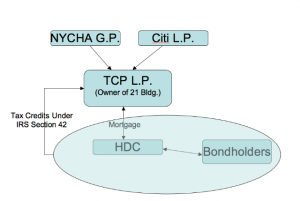
NYCHA will sell leasehold positions in the 21 buildings to a tax credit partnership (TCP) whose general partner will be NYCHA and whose limited partner will be a tax credit investor (in this case Citibank). The TCP will take out a mortgage from the New York City Housing Development Corporation (HDC). HDC will fund this mortgage by issuing tax-exempt bonds which will be paid down by the TCP using cash flow from the 21 buildings.

Properties that receive financing backed by tax-exempt bonds are eligible to receive tax credits for a period of 10 years. As a 99.99% owner in the TCP Citi will receive 99.99% of the tax credits generated by the property. In return for these tax credits Citi will provide capital to the TCP which will represent part of the $400m discussed above. The mortgage and the bonds will be paid down using cash flow from the 21 buildings which will be generated as a result of the $75m in annual subsidies. Following is a diagram that illustrates the transaction.

lihtc

Any questions?

It is well know that real estate markets are inefficient. You’ve heard the comparisons before: the stock market operates highly efficiently, but real estate markets are highly inefficient with each transaction consisting of a different seller, buyer and negotiation.

We saw a great example of this inefficiency when one of my appraisers, Steve, was verifying a sale transaction in connection with an appraisal (for those that don’t know, verifying a sale with a party to the transaction is part of the appraisal process, cause you can’t always believe what you read in the public record!). The cap rate suggested by the broker’s set-up seemed very low and he wanted confirmation that it was accurate, or better understand the buyer’s thinking in accepting such a low return.

After speaking with the buyer it all became clear: The buyer got her set-ups mixed up and thought she was buying a building on one block with one rent roll, but accidentally bought a building two blocks away (with a lower rent roll). Didn’t realize it until after closing. Whoops! That explains it! She bought the wrong building. Well everyone makes mistakes…and it is an inefficient market!

By Tyler King, Resident Hipster

Here at Miller Cicero, LLC we offer valuation services involving a wide swath of property types. Furthermore, our services are often requested for a wide range of reasons. Litigation, refinancing, asset management, the list is about as long as my arm. During the last building boom, we did a lot of work involving new construction. New construction is always an exciting venture because it involves lots and lots of different people. When you look at the soft cost budget for a project you have architects, engineers, lawyers, consultants, and, about 14 items down, you have the appraiser. All of these people are working together to create a brand new building. This new building will forever (or at least into the foreseeable future) alter the landscape of the surrounding area. Where before there was an underutilized site, there will now be apartments or offices, with people living and working inside of them. I don’t want to get all existential on you, but it is like a total happening.

Any new building will greatly influence the surrounding area. Often, these influences are what all the fuss is about when a new building is purposed. Neighbors are concerned about context, aesthetic and density, among other things. However, besides the long-term impacts the construction process itself will also have an immediate and substantial affect on the surrounding area. When a building is built, during demolition and foundation work a lot of earth that was previously lying still is moved around. Also, older neighboring buildings which had begun to lean a bit on adjacent structures lose that comforting shoulder after demolition.

I was on an inspection today in Williamsburg and snapped a few photos of a development site across the way. Looks like the building next door to the big hole in the ground lost its friend and its shoulder to lean on. Cracks can be seen all up and down the western portion of the building. Shoring has been put up, presumably after the fact, to prevent further damage but it looks to me like that corner is about to take a swim in the mud pit next door. If I owned that building, I would open a burger shop and exclusively serve “lean” beef.

100_5907

100_5908

I’ve been reading with much interest all of the hoopla regarding the Superfund designation of the Gowanus Canal. The New York Times had a good article on it recently (from which I’ve borrowed this photo!). Don’t really understand the controversy…I mean, isn’t it a good thing that this former industrial waterway full of PCB’s and sludge is finally going to be cleaned up? I mean, sure, nobody’s going to want to pay the gazillion dollars required, but it’s a small price to pay to transform a canal that has historically been a punch line into a basin with clean water, happy fish and parks and new residential developments along its banks. Think little kids on swing sets and puppies and kites replacing the concrete and block heavy industrial factories. Think Gowanus Resort and Spa!

The City planner’s vision for the canal seems almost too far-fetched to believe, but then again, there were probably lots of non-believers when the city announced that one of the seediest areas in Manhattan, Times Square, was going to be transformed into a Disney-like theme park…

24gowanus-600

Source: Photo from the New York Times

by James Dunne - The CREative Department

I shall never use profanity except in discussing house rent and taxes. ~Mark Twain

January 5th, this is the day when NYC property owners get to find out what their tax bill will be, this is because it’s the day the NYC Dept. of Finance issues its tentative property assessments (assessment roll), which is an updated market value, of all real property in NYC. However, the assessor’s “market value” is often only a small fraction of the actual price a property would sell for in the open market.

To value property, the Dept. of Finance uses a sales approach, a cost approach, or in the case of multi-family properties, which I’ve been covering in my Multi-family Building Blog series, they use an income-based approach. Property owners can submit their building’s income to the NYC Dept. of Finance (an RPIE filing) to calculate their building’s taxes; however, the Finance Department usually just uses an estimate. Once the Department of Finance decides a property’s value, they issue a Notice of Property Value (NOPV) to the owner, and then a tax rate is applied. Most multi-family properties are designated as Class 2 properties, which are currently taxed at a rate of 13.241%.

The real issue of course is how the Dept. of Finance calculates their “market value” based on a building’s income. For a clue to this, I looked at a list of multi-family buildings data that Dept. of Finance publishes each year that it uses as comparables for co-op and condominium taxation (the Dept. of Finance treats co-op and condo buildings as Class 2 buildings also for taxation purposes). I looked at two indicators: the GRM (the gross rent multiple), and the gross rent per square foot. I analyzed the averages (mean) for over 1000 multi-family properties. For the GRM, the Dept. of Finance has an average multiple of 4.28, with a high of 5.04 and a low of 2.82, with a standard deviation of 0.54, meaning they value most of the properties (68%) based on a GRM of between 3.74 & 4.82, a fairly tight range. The gross rent per square foot was less reliable with a low of $7.64/SF to $46.40/SF, with $26.42 as the average, and a wide standard deviation of $9.52.

So in terms of estimating market value, the numbers might suggest that the Department of Finance bases their market value, and ultimately the tax a building owner pays, on the GRM of a building. It’s important to keep in mind, that the building’s gross rents’ themselves are often estimates by the Dept. of Finance. However, if a building owner feels they are being over-taxed, they can always file for a tax appeal.

  • Categories

  • Tags