Archive for April, 2012

There are countless books and websites purporting to offer easy techniques for striking it rich in real estate. I’d like to toss my own hat into the proverbial ring and offer a simple, foolproof, step-by-step process for achieving this goal.

Step 1: Become famous.
Step 2: Buy a condo apartment.
Step 3: Wait for values in the building to rise as a result of your fame.
Step 4: Sell at a tidy profit.

Of course, this process can be repeated again and again in as many different buildings as you’d like. Eventually you might become even more famous due to your real estate prowess, which would then lead to greater fame-induced profits, which would lead to more fame, and so on.

Sound to good to be true? According to a recent Wall Street Journal article, Alex Rodriguez of the Yankees has recently done exactly this. He closed on a 3,600 SF, four-bedroom apartment on the 35th floor of the Rushmore (80 Riverside Boulevard) in June 2011 for $5.5 million. Brokers have stated (or perhaps more accurately, speculated) that A-Rod’s well-publicized purchase led to increased sales activity and prices within the building.

Just four months later in October 2011, Mr. Rodriguez put the apartment back on the market with an asking price of $8 million. The unit went into contract in January 2012, and brokers familiar with the sale reported that the contract price was sufficiently high so as to net Alex a substantial profit on the unit. (As of this writing, City records do not show a deed transfer for this deal, so apparently the sale has not yet closed.)

Now, that’s what I call a HOME run!
Location, location, location. An inherent quality of real estate is that no two properties share the exact same location. Making appropriate comparisons between properties with disparate locations is one of the basic challenges in the practice of real estate appraisal.

One basic aspect of a property’s location is the street along which it is situated. Within a given neighborhood, some streets are typically regarded as more desirable than others, for any number of possible reasons. While we don’t normally pay much attention to the character of a street’s name in and of itself, it is entirely possible that in some cases, the particular name of a street may have an effect - for better or for worse - on its image and appeal.

As covered in the NY Times and elsewhere, a group of shareholders in the Southgate co-op complex are convinced that changing the name of their street would result in higher property values. The Southgate complex is located along the easternmost block of East 52nd Street in the prestigious Turtle Bay neighborhood of Manhattan. These co-op owners are seeking to change the name of the street along their block to something more elegant; a leading contender is “River Place”. Their theory is that this renaming would give the block greater cachet, and bring property values up to the levels enjoyed by similar properties located nearby on Beekman Place to the south and Sutton Place to the north.

While it is unclear whether their efforts will be met with any success (full-blown street name changes within Manhattan are by no means an everyday occurrence), I must agree that River Place has a better ring to it than East 52nd Street. Would such a name change actually result in higher values? Some brokers interview by the NY Times believe that it would. Ultimately, only the market could answer that question definitively.

One of the first things we learned way back when in real estate appraisal class was the theory of neighborhood life cycles: growth, stability, decline, revitalization. These cycles are evident throughout New York City. We saw Williamsburg from from an industrial community, Harlem revitalize over the past decade and now we are witnessing the revitalization of the South Bronx, or “SoBro” to some. This neighborhood has come a long way from when Paul Newman roamed its streets in the movie, Fort Appache: The Bronx. (To be honest don’t recall the movie other than a lot of people getting shot!)

In Joseph Berger’s article in the New York Times last week, No Longer Burning, The South Bronx Gentrifies, the South Bronx is described as the next new thing where young professionals are coming in search of that holy grail, SPACE! And not just space, but affordable space. It’s true that at one time the Grand Concourse was a status symbol designed after the Champs Elysee in Paris…but that was a long time ago. But slowly, some of these buildings are coming back..much of of it in the form of government-subsidized housing. We are still a long way from seeing a Starbucks and truffled mac ‘n cheese there, but will no doubt be interesting to watch what happens here next.

By James Dunne - The CREative Department

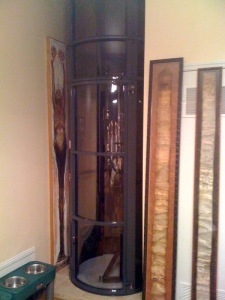
We live in a vertical city. Elevators shuttle us to our offices and apartment. However, much of NYC’s housing-stock still consists of walk-up brownstones, and while most are just 3 to 5 stories, for the elderly or anyone that has trouble climbing stairs, this poses a problem, but to install a traditional elevator in a brownstone, if it’s even feasible, will typically run from around $120,000 to $150,000 for the equipment, labor and typical work required on the house, on top of this.

Enter the pneumatic elevator. They take up less than half the space of the smallest of traditional elevators, and cost a fraction of the price. Typically around $30,000 to $35,000. Pneumatic or tube elevators work by creating a vacuum, which sucks the cylinder car up to the floors. I took a ride in one, and they work great. Despite being widely available around the US, these are not yet approved for use in the five boroughs, however, I’ve heard that the NYC Buildings Department may soon be approving them. Overall, they’re a practical and cost effective alternative to a traditional elevator for smaller buildings.

elevator1

  • Categories

  • Tags