Archive for January, 2011

The tenants and landlords are apparently getting ready for another battle as rent stabilization comes up for renewal. According to an article in today’s Wall Street Journal, Democrats Focus on Rent Overhaul, State Assembly Speaker Sheldon Silver wants to tie in the renewal of 421a tax benefits with greater rent stabilization protection. The Senate Republican majority, traditionally representing the interests of the landlords, will fight to weaken regulation.

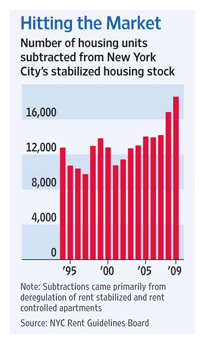
According to the Rent Guidelines Board 2010 report, Changes to the Rent Stabilized Housing Stock in 2009, there was a net loss of 10,052 rent stabilized apartments in 2009 (aan increase of 22% over 2008 and the highest single year loss since RGB began producing its report. Subtractions from the rent stabilized building stock may be a function of:

  • Luxury/Vacancy decontrol
  • Co-op/Condo Conversions
  • Expiration of tax benefits (421a and J-51)
  • Substantial rehabilitation
  • Conversion to commercial use
  • Other losses such as demolition and condemnation

This is summed up nicely in the following graph, reproduced from the Journal article:
rent stab apts

My guess is that at minimum the threshhold for luxury decontrol will be increased from the current $2,000, which has been unchanged since the Rent Regulation Act was enacted in 1997. Should all make for some interesting theater in Albany.


Hot off the presses…the Department of Finance has just released their tax guidelines for FY 2012. (FY’ 2012 Guidelines for Properties Valued Based on the Income Approach). The guidelines, used by assessors, reflect the target percentage of income that real estate taxes are intended to comprise: for example taxes on class A office buildings are targeted at 23% to 26% of income (not specified, but i assume effective gross, rather than potential gross), and retail properties as high as 33%! The lowest taxes? Apartment building with fewer than 10 units and grossing less than $8.39 per square foot, only 12.01% of income!

by The Affordable Oracle

In the last couple of weeks at least two properties have come to market that had just been purchased less than a year ago: 205 Montague Avenue in Brooklyn is a office building just came to market with an asking price of $49m, the seller purchased the building for $33m just six months ago. 20 West 40th Street is a development site in Manhattan diagonal from Bryant Park that is on the market for $85m, the seller purchased the site 7 months ago for $46m.

Buying and selling a property to realize quick profit is known as a “flip” and one of the reasons for the existence of a flip is the incentive structure built into a traditional real estate investment partnership.

In the most common structure the owner entity is a LLC with a general partner (Managing Member) and investor (Member). The profit splitting arrangement typically calls for a preferred return (hurdle rate) to the investor and a split of the returns (between the investor and general partner) above the hurdle rate. The return that is split is known as carried interest.

This arrangement motivates the managing member to sell quickly and lock in his carried interest in circumstances where there is a spike in the investments value in the early stages of the investment. This allows the managing member to take a higher percentage of the total investment returns than if he were to sell it later.

Lets go through a simple illustration.

Lets say we formed an investment partnership to buy the Bryant Park site for $30m and as the Managing Member we contributed 10% of the equity with the remaining 90% coming from our investors (Members). The investment was structured with a 10% hurdle rate followed by a 20%/80% split.

Lets say the returns (appreciation as this is land only) were as follows:

Year 1 – 40% market rebounds
Year 2 – 12%
Year 3 – 12%
Year 4 – 10%
Year 5 – 5%

The worksheet below illustrates the return waterfall and eventually highlights the variation in the percentage of total returns between the investor and the managing member depending on which year the property is sold. Note this percentage does not account for the time value of money and simply calculates the percentage of the total return to the investor versus the managing member. Adjusting for time value of money would only exacerbate the point. As you can see the managing member’s share of the return pie decreases the later he sells the investment. This causes the investor and the managing member’s interest to be unaligned as the managing member is attempting to capture more of the investment return pie. But generally speaking a spike in investment value is a happy time for the investor so it is unlikely that he will want to raise a conflict with his general partner who picked the investment in the first place.

Uploaded with ImageShack.us

  • Categories

  • Tags