Archive for January, 2010

I wrote about my frustration with the city zoning office the other day. My story does have a happy ending, though. I had sent a link to my blog post to Amanda Burden, chairwoman of city planning. To my surprise, my complaint to Ms. Burden did not end up in cyberspace….as yesterday I received a telephone call from the planner that actually wrote the text on the fresh market bonus. She was intelligent, articulate and apologetic…and proceeded to answer my questions. Later that day I received another phone call from the actual gentleman with whom I originally had my telephone exchange. He called to apologize and said there was “no excuse” for the way he had spoken to me.

Apologies accepted all around. All’s well that end’s well. The zoning guys are my pals again.

One of the great things about having a blog is being able to vent. In connection with an appraisal assignment I attempted to clarify a confusing issue regarding the new fresh market zoning bonus that was recently enacted. My question, in a C8-3 zone that permits a 2.0 commercial FAR and 6.5 for community facility uses, would the inclusion of a fresh market allow a commercial bonus in excess of the maximum 6.5 FAR, or additional commercial density within the 6.5 FAR? Kind of a technical question that was unclear (to me) from reading the ordinance. For clarification I called the zoning office and proceeded to have the most bizarre conversation that went something like this:

Me: Hi, I’d like to get some clarification on the fresh market bonus in a commercial zone.

Zoning: Fresh market bonus. What’s that?

Me: It’s a new zoning bonus that was recently approved.

Zoning: I don’t know about it. Did you try to find it in the ordinance? Do you know where it is?

Me: Yes. I read it and it’s confusing. It’s Article 6, Chapter 3, section 63-00.

Zoning: OK, Let me find it. We’ll read it together. What do you want to do on the property.

Me: I’m appraising the property so I want to understand the bonus.

Zoning (this is where it gets good): Appraising it? To appraise it you have to know about the zoning. How can you get the market value without knowing the zoning?

Me (starting to get impatient): Yes, I know. That’s why I’m calling you.

Zoning (being rude): You can’t just call zoning [That was my favorite part!]. You have to read everything and understand the zoning or how can you appraise it.

Me (starting to lose it): I read it and don’t understand it. That’s why I’m calling you. It’s clear that you can’t help me. Is there anyone there that would be familiar with this bonus that I can speak with?

Zoning (even ruder): Nobody here is going to talk to an appraiser (sneer…really!). Everyone is busy doing things. Nobody will talk to an appraiser. You have to read everything.

Me (convinced that I am on Candid Camera): Why is that? Are appraisers not worth their time?

Zoning (having had enough of me): They are too busy. I will read the zoning text with you. Hold on while it comes up on my computer.

At this point I hung up. And all I could think about is, with the drastic need to save taxpayer dollars, I have an excellent place to start!

Of the city’s nearly 2.1 million rental units about nearly half are rent stabilized. This uniquely New York form of rent protection has evolved into one of the most arcane systems of rent regulation in the country.

Rent stabilization don’t just stipulate how much of an increase is permitted annually for a 1 or 2 year lease renewal. (If you haven’t seen the clips of the hearings with the rent guidelines board and tenant groups negotiating on annual increases on the evening news, you’ve been missing some great theater. All civil discourse breaks down as each side claims poverty and screams at the other, seeking to portray them as greedy and dishonest.) Rather the guidelines are an intricate flow chart of “if A then B” rules that have tenants and landlords alike scratching their heads. For example,

Where a lease for a dwelling unit in effect on May 31, 1968 or where a lease in effect on June 30, 1974 for a dwelling unit which became subject to the Rent Stabilization Law of 1969, by virtue of the Emergency Tenant Protection Act of 1974 and Resolution Number 276 of the New York City Council, contained an escalator clause for the increased costs of operation and such clause is still in effect, the lawful rent on September 30, 2008 over which the fair rent under this Order is computed shall include the increased rental, if any, due under such clause except those charges which accrued within one year of the commencement of the renewal lease.…

Huh?

Advocates of the rent stabilization laws insist that these guidelines are a critical component of the City’s affordable housing stock. If that were true it might be a somewhat valid argument. But holding a rent stabilized lease these days is one of the most broken and abused systems that we have and is akin to winning the lottery; rent stabilized tenants could just as easily be hedge fund managers as day laborers. I know there are many tenants with wildly below market stabilized leases that could, as a consequence, buy weekend homes in the country. And who could forget Congressman Charlie Rangel’s four rent stabilized apartments in Harlem.

Decoding rent stabilization is one of my favorite past times. More on this to come in the future.

by Gleb Lerman, The Affordable Oracle

It was just announced that Carl Ichan won the partially completed $3.0b Fontainebleau casino project in Las Vegas. Wining price: $150m im not sure if this requires Mr. Ichan to take on any liabilities, but it seems like it does not. According to Wikipedia there was over $2.0b already invested in the project and the property has been topped out. Recent pictures also show that a majority of the curtain wall was already installed. Estimates to complete the project range from $1-$1.5b. Mr. Ichan has been described as a corporate raider and has in the past bought companies in order to liquidate them. My question is will Mr. Ichan be able to see a higher return by selling off the curtain wall to another project and scrapping the steel from the project than completing the project? I wonder if Mr. Ichan is back to his raiding days.

main

by James Dunne - The CREative Department

As a commercial real estate appraiser, I analyze the income producing capability of properties, often multi-family buildings. One problem routinely encountered is the wild variation in expenses reported by building owners and management companies, which adds to the difficulty in averaging and projecting expenses for buildings. This will be the first in a series of blog posts where I look at some of the expenses encountered for multi-family or income producing buildings.

Speaking of management companies, unless a building owner has the time to self-manage, they will need to contract out management of a building to an outside company. While management fees can vary greatly, 3% of the yearly gross building income (rent) is typically charged by many management companies in New York City - especially for buildings with a larger number of units (usually in buildings of twenty or more units). Working on a percentage of the gross rent creates incentive for the managing agent to maximize the rent. With smaller buildings also may be charged a percentage of rent, the percentage may be higher, but a flat fee is sometimes negotiated also. When a management company is hired by the board of a co-op or condo building, a flat monthly fee is always charged. What do building owners get for this? It’s usually A to Z. The management company will take care of bookkeeping and basic accounting including the accounts receivable and accounts payable for the building. Management will maintain utility accounts, including water/sewer, heating, common eclectic and deal with insurance companies. They will get estimates for and coordinate repairs in the building, and they will hire and supervise a building super or a cleaning/maintenance person for smaller buildings. In a rental building, the management is responsible for renting out units as tenants vacate.

For small buildings that negotiate a flat fee, management may charge as little as $500 a month for 6 to 8 unit building, but there’s no standard. One managing agent I spoke with said he was changing $800+ a month for an 8 unit building, but was also charging $800+ for a 20 unit building. With a co-op or condo building, if the management company also has real estate brokers on its staff, it may charge a relatively low monthly fee just so the company can get the inside scoop on any owners that may be selling. If a co-op or condo building has a high turnover, this may be more profitable than the management fees.

The take-away is that there is a wide range of fees that are charged, and that all fees are negotiable. However, in dealing with management companies myself when I worked as a full-time real estate broker – a building owner or co-op board can save itself a lot of money and hassle by hiring a management company with a good record and reputation.

by Gleb Lerman, The Affordable Oracle

Last week John mentioned that the Tishman acquisition of Peter Cooper Village/Stuyvesant Town (PCV/ST) will undoubtedly be a case study in business school. As a business school student who is a big fan of the case method I began thinking of what conclusions will the PCV/ST case illustrate. The first thing that came to mind was that there exists a similar case with similar lessons and even a conclusion. What I am referring to is the acquisition of Rockefeller Center by the in the 1980 and the subsequent sale of the property to Tishman Speyer.

The story went something like this: In the early 80’s the Rockefellers decided to sell Rockefeller Center to raise the levels in the old piggy bank however they were unable to find a buyer willing to buy the complex on acceptable terms. So in 1985 they created a public REIT (Rockefeller Center Properties) whose sole purpose was to issue a $1.3b mortgage on Rockefeller Center. Once the mortgage was issued the Rockefellers were left with $1.3b in cash and an equity position in Rockefeller Center. In 1989 the Rockefellers went on to sell 80% of their equity in Rockefeller Center to Mitsubishi Estate, a Japanese investment company for roughly $1.4b which brought their total cash out to $2.7b.

Shortly after the sale the NYC real estate market took a nose dive and Mitsubishi’s $1.4b equity position did not produce a single dollar of cash flow as all the money was eaten up by the mortgage. In fact by 1994 it is reported that Mistubishi had thrown in an additional $460 million into Rockefeller Center to cover the gap between cash flow and mortgage payments. By mid 1995 it was apparent that Mitsubishi would walk away from the property and the REIT who had issued the mortgage would become the owners of Rockefeller Center. The REIT’s share price has plunged from an initial offer price of $20/share to less than $5/share.

In November 1995 a syndicate which included David Rockefeller, Goldman Sachs and Tishman Speyer (minority partner and property manager) bought the mortgage from the REIT in a transaction that valued the complex at $1.13b. The Rockefeller/Goldman team was up against several other bidders including Sam Zell but managed to win in part because in 1994 Goldman provided a highly restrictive loan to the REIT which included, prepayment restrictions, warrants, and restrictions on new debt. This restrictive loan gave Goldman a competitive advantage over other bidders.

In December 2000 Tishman Speyer upped its minority stake in Rockefeller Center to full ownership with the Crown family as partner and for the first time the Rockefellers relinquished ownership in the Rockafeller Center. This acquisition valued the property for $1.85b.

Some lessons to be learned:

It’s not how you play the game it’s with whose money you play the game with:

In physics what goes up must come down but in real estate what comes down will likely go up

While it’s psychologically natural for losses to feel worse than gains don’t throw good money after bad (Mitsubishi)

It’s not how you play the game its if you play the game

It’s good to be a Rockefeller

A foot in the door can be very valuable, don’t sell your foot for the price of a foot.

Feel free to correct any fact discrepancies or other lessons to be learned from the Rockefeller Center case.

by Tyler King, Resident Hipster

Frank Zappa once said, “Jazz is not dead – it just smells funny”. Well I think the same could be said about the current economy. It stinks, but it is showing signs of life. I could not sleep last night in anticipation of the Fed releasing its bi-quarterly publication commonly known as “The Beige Book”. Market participants across all sectors look forward to this because it is viewed as an objective, non-partisan overview of the economy. Also, I heard Dan Brown ghost-wrote the introductory summary.

So the general tone of the book was what I would call “subdued optimism”. The number of home sales was up both nationally and within the New York District. Furthermore, here in New York City, home prices continued to decline, however at a much more moderate pace. This is all fine and dandy for the residential side of things, but the outlook is not so rosy for commercial real estate.

In regards to the New York District specifically, my favorite line was, “Commercial real estate markets were steady to softer in the fourth quarter, with the sales/investment market remaining moribund.” Sounds to me like someone got a little carried away with the thesaurus over at The Fed. For those who don’t already know what moribund means, it is generally defined as: “in a dying state”. Ouch! Other bad economic news from the report includes hotel room rates falling and office rents at Class A properties continuing to tumble.

However there were signs of life. Hiring activity is picking up and both manufacturers and other firms plan to increase employment levels in the first half of 2010. At the same time residential rents have started to show signs of stabilizing, as landlords begin to offer less aggressive concessions.

So, I suggest grabbing a cup of hot cocoa and curling up with your own copy of The Fed’s Beige Book. Read it through, take it in, and look for signs of life. My take: the economy is not dead – it just smells funny.

The Stuyvesant Town acquisition by Tishman Speyer and Blackrock will no doubt be a case study for business and real estate students for years to come. It’s got drama, intrigue and 80 acres of sexy real estate. The $5.4 billion acquisition price was the largest residential transaction in US history, and the court ruling that rents were improperly raised to market levels (while receiving J-51 tax benefits) sent shock waves through the industry. And now, the owners are officially in default of their bond payment. The saga of Stuy Town is far from over!

At the height of the market investment sales brokers reported that demand for product was so strong that the winning bidder was inevitably the one that would underwrite the most aggressive rental growth. I can just imagine the kind of cash flow models that the analysts at Tishman and Blackrock generated in order to justify the price tag. I would have loved to listen in on that presentation to senior management. (So, Mr. Speyer, all we do is turn over 10% of the rent stabilized units in the first two years and bring them to market…) With one simple change in the model’s assumptions (7% rental growth in years 2 through 5 instead of 6%?), the impact on value can be dramatic. Of course, every major asset that is now on the brink of default used similarly optimistic assumption.

When the dust settles, this will no doubt be one for the history books. Or maybe I’ll just wait for the movie.

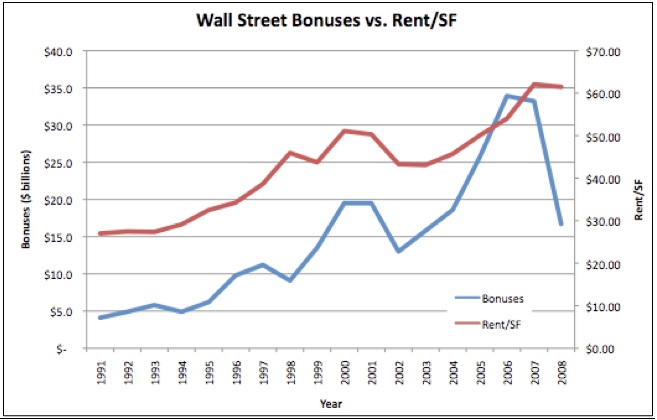
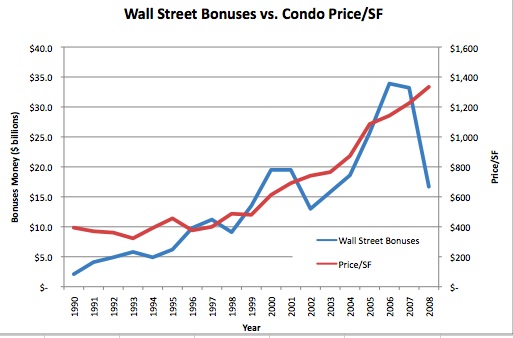
Wall Street is abuzz with news of bonuses. A front page story in today’s New York Times notes that 2009 could be one of Wall Street’s biggest year’s for payouts. As distasteful as this might be to some people, New York real estate folks say “bring it on!” As bonus money increases, so does the demand for high-end real estate.

There has historically been a direct correlation between Wall Street bonuses (as reported by The New York State Office of the State Comptroller) and the performance of residential real estate. My firm did a study on this about a year ago and the correlation is quite clear:

bonus-condo

Source: Miller Cicero LLC, based on employment data from US Bureau of Labor Statistics (BLS)

bonus v rent

Source: Miller Cicero, LLC, based on bonus data from the Office of the State Deputy Comptroller

Call it Wall Street’s contribution to a financial stimulus. With an average bonus of over $500,000 per employee (that’s average…bonuses can run into the tens of millions for some!) I have to believe that many of those shiny, new and vacant luxury condos will be snatched up over the next couple of months.

by Gleb Lerman, the Affordable Oracle

New York City has one of the best online public record systems I have seen…and it just got better! Now you can look up Property Tax Benefit Information. For now the site just shows property tax exemption benefits which includes programs like 421a, 421b, 421g ICIP, J51, DAMP and UDAAP. Details include benefit start date, end date, and all the other calculations that go into calculating the amount of the exemption. The information can be found here: https://a836-propertyportal.nyc.gov/

Here are some other websites that should be part of the utility belt worn by every NYC property owner, investor, developer, real estate lawyer, and appraiser.

J-51 Benefit History Request Screen:

http://webapps.nyc.gov:8084/cics/cwba/dfhwbtta/abhq

NYC Department of Buildings Building Information Search:

http://a810-bisweb.nyc.gov/bisweb/bispi00.jsp

ACRIS Automated City Register Information System (Deeds Mortgages, Ground leases, ZLDA):

http://www.nyc.gov/html/dof/html/jump/acris.shtml

Zoning Maps:

http://www.nyc.gov/html/dcp/html/zone/zonedex.shtml

Zoning Reference:

http://www.nyc.gov/html/dcp/html/zone/zh_resdistricts.shtml

Zoning Glossary:

http://www.nyc.gov/html/dcp/html/zone/glossary.shtml

Assessment Information:

http://nycprop.nyc.gov/nycproperty/nynav/jsp/selectbbl.jsp

Property Shark- A paid service that aggregates all the data above and more:

www.pshark.com

  • Categories

  • Tags