Archive for April, 2010

by Tyler King, Resident Hipster

Within the real estate industry there are many different professionals. Mortgage brokers, selling agents, buying agents, loan originators, developers, construction contractors, architects, lenders, equity investors, and of course, appraisers. It is common knowledge that appraisers, and more specifically commercial appraisers, are not only the smartest and wittiest of the bunch, but they are also the best looking of all the real estate professionals. Being such an elite bunch, we as a group have developed our own lingo. A language, that until now, outsiders couldn’t understand. Well, I am breaking the code of silence and I am going to explain some words, phrases, and activities that are often misunderstood, or seem downright alien to most outside of the underground world of appraisal.

Due Dilly: We as appraisers are part of the due diligence process that gets deals done. We eat sleep and breath due diligence. Being that “diligence” is not only hard to spell (I always think there should be two L’s) and we say these words about six hundred times a day, we typically refer to it as the more casual and hip “due dilly”. This abbreviation (or “abreev” as we like to say) typically saves us about 23 seconds a day that we can devote to finding comps.

O-Rag: This is the guy that shows up to appraise your house. He works from home and spends upwards of 8 hours at a time in the car. His car is typically a 2001 Honda Accord with 174,000 thousand miles on it. Due to a lack of social interaction he is generally referred to as an Odd Residential Appraiser Guy, or O-Rag for short.

J Factor: An income adjustment or stabilization factor used to convert a stream of income changing on a curvilinear basis into its level equivalent. In other words, no one really knows what the hell a J factor is, but we just can’t stop talking about it.

Comp Request: An email or fax from an appraiser that is sent out within minutes of getting assigned to appraise any building containing retail. Typically the appraiser has decided that it is going to be too hard to call a broker or do some legwork, and it would just be easier if someone else could do it for him.

Appraisal Pressure: Any phone call from a mortgage broker that took place between 2006 and 2008.

Appraisal License Courses: A form of medieval torture that has seen a renaissance since the state licensing requirements took effect.

Comp Bomb: A rent roll or collection of comps from a brokerage or appraiser that contains a bunch of recently executed leases. Nothing beats opening up your email to find a comp bomb on a dreary Monday morning.

Comp Angel: The person who sends out Comp Bombs. My comp angel is this guy named Amit.

Inspection: The process of an appraiser walking through a property while being told by the owner how much it is worth.
by Gleb Lerman, The Affordable Oracle

Appraisers are not generally thought of arrogant, but I can assure you there are many arrogant appraisers, some that even work here at Miller Cicero. The easiest way to find them is to look at their values. An arrogant appraiser will tell you an office building is worth $257,000,000 while a humble appraiser working under the same assumptions will tell you that same office building is worth $260,000,000. The level of precision implied by the first value is to the nearest million while the error of precision implied by the second value is to the nearest ten million. In my opinion on average commercial appraiser should never imply a degree of accuracy of more than 5% and should thus adjust his/her rounding to reflect such a degree of accuracy. So if you’re valuing a property worth around $1,000,000 you should round at least to the nearest $50,000.

Your level of rounding can also speak of your confidence in the data/analysis. So a crude, back of the envelope consulting assignment should reflect a higher rounding percentage than a very detailed appraisal with excellent market data.

To give credit where it’s due, this post was inspired by a book I am reading: The End of Wall Street by Roger Lowenstein. In which he describes how Merrill’s portfolio of CDO’s was calculated as having a potential loss of $71.3 million, which was deemed way too accurate of an estimate for such complex securities. (As well as Michael Falsetta who brought the “implied precision” concept to my attention way before Merrill’s CDO portfolio went kaput.)

In a New York Times article today, Railyards Deal May Still be Weeks Away, it was reported that Related Companies and the MTA had agreed to a plan in which Related would put down $21.7 million down payment to reactivate its dormant West Side rail yards development. Per the Times

“Under the plan, Related would commit to a 99-year lease on the 26-acre railyards for $1 billion, the original price. But three specific measures of the real estate market, including average prices for Manhattan co-op and condo sales, must be met before the company would be forced to close on its contract; in the earlier plan, Related would have had to close within 150 days of signing.”

The basis for determining when this $1 billion development goes forward? The market reports prepared by our very own JMillz (as Curbed has dubbed Jonathan Miller!). According to the April 26th Staff Summary agreement, there are three “triggers” for the development to move forward: (1) commercial office availability; (2) construction/finance activity and (3) residential condominium pricing. In this it is stated:

(iii) Residential Condominium Pricing Trigger: The Residential Condominium Pricing Trigger will be considered “on” during any period (x) commencing on the date that the Miller Samuel Manhattan Residential Condominium and Co-op Market Overview — Manhattan Market Matrix — Average Price per Square Foot is published with respect to a quarterly period and such Average Price per Square Foot for such quarterly period is equal to or more than the simple average of the following (the “Trigger Average”):

(1) The highest Average Price per Square Foot from the previous four quarters;

(2) The lowest Average Price per Square Foot from the previous four quarters; and

(3) Twelve hundred dollars ($1,200) per square foot; and

(y) terminating on the date that the Miller Samuel Manhattan Residential Condominium and Co-op Market Overview — Manhattan Market Matrix –Average Price per Square Foot is published with respect to a quarterly period and such Average Price per Square Foot for such quarterly period is less than the Trigger Average.

I

We’re out and about the streets of New York all the time, and every so often something interesting catches our eye…

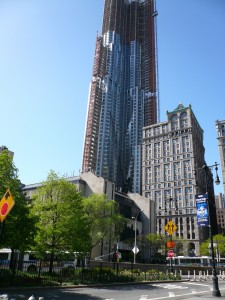
The Frank Gehry designed Beekman Tower, under construction in lower Manhattan, near the Brooklyn Bridge, will be the tallest residential tower in Manhattan.

P1000003

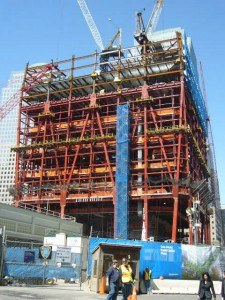
Work is also progressing on the first tower at the World Trade Center. Now that construction is underway, I expect that this frame is going to sprout up very quickly.

P1100496

by Gleb Lerman, The Affordable Oracle

Yesterday I had the pleasure of attending ULI’s Private Equity Symposium. The event was a 5 person panel which included GP’s, LP’s and fund raisers. At the event I got to see some insider perspectives from well known private equity players.

In speaking of the overall real estate market both GP’ and LP’s were in agreement that there is possibility of a “double dip” given a high probability of a reversal of currently low interest rates. My personal gut feeling is that opinions expressed at such panels lag the market reality. In other words as the panel is saying “we may be near the bottom” what’s really going on is that we are at the bottom. And when the panel says “we appear to be at the bottom” the market is already on the recovery leg. One panelist did point to the fact that there is no need to buy at the absolute bottom so long as you expect the recovery over the holding period to be sufficient to coutercompensate.

Another theme of the conference was that debt is the new equity. With most leveraged deals now under water sponsors have become nothing more than building janitors, managing the buildings for the debt holders. Many development loans which are clearly underwater are remaining to stay as “current” on lender’s books as the as project is slow to draw down interest reserves (low interest rates). As a result the only market activity that is taking place is on the debt side and even there the banks & REMIC’s are reluctant to sell leaving FDIC loan sales as one of few buying opportunities.

GP’s and LP’s have emphasized a newfound importance of local operating partners as today’s market requires more “hands on” approach. At the same time both GP’s and LP’s raised a valid concern that local operating partners are facing organizational issued as they redirected their efforts from acquisitions to asset management.

Overall the conference provided a good understanding of what challenges and opportunities are in store for the industry and I am hopeful ULI will continue to make this a regular even.

Doormen throughout New York City were set to go on strike at 7 am this morning if a new contract could not be agreed on. At the last minute, the two sides, the building owners and Local 32BJ of the Service International Employees Union. The union won a new four-year contract and a total pay increase of 10%, according to an article in today’s New York Times (Deal Reached That Averts a Walkout by Doormen).

On average the union workers, which include porters as well as doormen, earn a salary of $40,000 per year, however with benefits the cost to ownership is closer to $70,000, or roughly 75% of base salary! According to the Real Estate Board of New York, the Apartment Building Agreement that was negotiated in 2006 (and expired this morning) calls for contributions to employee’s welfare (health) fund of nearly $11,000 per employee per annum, contributions of about $60 per week to the employee’s pension fund, and additional contributions to a Scholarship and Safety Fund, a Legal Services Fund and an Annuity Fund. These payments are in addition to paid vacation and sick days (I didn’t see how many days they get…anybody know?)

Sounds like a pretty good deal to me. Anyone need a doorman?

by James Dunne, The Brooklyn (Bronx?) Brain

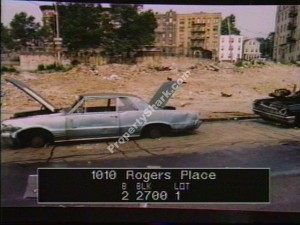
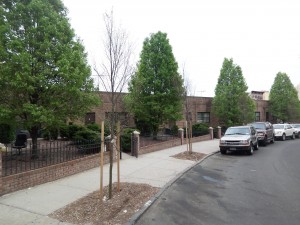
In the mid-1980’s the NYC Department of Finance, the agency with the power to tax property in the five boroughs, undertook a project to photograph every block & lot in NYC (updating their files from an earlier effort from ’39-’41). While researching properties for a market-rent survey I was conducting in the Bronx recently, I came across some lovely photos of the Bronx in the 80’s. To illustrate the stark contrast between then and now, and to show how drastically the Bronx has turned around, I pulled a Dept. of Finance photo of 1010 Rogers Place from Property Shark, and took a photo of that same property on April 16, 2010:

1010 Rogers Place

100_6179

100_6178

Back in the 80’s this was a vacant lot (sans burnt-out cars), now there’s an 18-unit low-rise apartment building on the lot with a manicured garden. Across the street there’s a new playground for children. The Bronx is certainly not burning anymore. Gentrification can be a very good thing.

Remember The Producers? Nathan Lane and Matthew Broderick singing about making a fortune from orchestrating a flop on Broadway. It was sheer genius…if they could produce a flop, their investors would lose a ton of money, and they would walk away rich men. Sound familiar? That’s essentially what Goldman is accused of in the SEC suit brought last week. They are alleged to be betting against the CDO’s they were selling to their investors.

On last week’s podcast of National Public Radio’s This American LIfe (The Inside Job, April 9, 2010) they tell the story of a hedge fund, Magnetar, that made billions in buying the credit default swaps that would pay off 100-fold if the CDO’s they they actually helped to create failed. And, to drive home the parallels with The Producers, they put it it to song:

Click here to play the song

One of the great things about New York is that it thinks big. Tall skyscrapers, entire new neighborhoods created from former industrial riverfronts, the largest subway system in the world…you get the idea. So it will be particularly fascinating to watch plans for Governor’s Island unfold. The island, a former military base that sits in the harbor, has just come under the city’s control. In today’s New York Times, they published some of their reader’s more whimsical ideas as to what the city could do with an entire island. One idea, create a huge wetlands to improve the environment; another, a teacher education center. The Bloomberg administration has already said that it will likely be developed partially with a park with portions set aside for private development.

I think the answer obvious. An island, off Manhattan just screams theme park! Why have to go all the way to California or Florida when we can have our very own Disney New York! (C’mon, Rob Iger, tell me you haven’t thought of this already!) The park can have five little “boros” each with its own theme (“Gangs of New York”, “New York Underground”…work with me here)… plus a little Hamptons Village with man-made beach (and lots of chic souvenir shops…) And our Pleasure Island would no doubt put Orlando’s to shame.

I’ve got lots more ideas, but I can’t just give them away. But I am available for hire to consult with any Disney Imagineers!

by Gleb Lerman, The Affordable Oracle

This past weekend in my entrepreneurship class we were discussing LBO (leveraged buyout) deals gone bad. LBO’s go bad either due to initial overpayment or an unexpected change in the competitive landscape. Resolution to bad LBO deals follow one of two options: liquidation, or a prolonged holding periods where the LBO sponsor holds the company for a period substantially longer than initially expected, in other words, trying to grow the company out of its debt.

Analogizing bad LBOs to bad real estate deals I brought up the questions of whether LBO sponsors can buy back the debt at a fraction of the principal amount like many real estate sponsors are now doing. Many debt buy backs are so attractive that they actually help the sponsor salvage the initial equity investment. There are numerous reasons cited for why loan buy back by the sponsor seldom occurs in LBO deals.

One explanation for why discounted debt sales to the sponsor occur in real estate and not LBOs is that LBO loans are often syndicated across many banks and a successful debt sale requires agreement by a majority or in some cases all of the syndicate banks.

Well guess what?…many real estate loans have been syndicated and as a result sponsors looking to buy back the debt on their projects are having a tough time negotiating with their lender(s). Luckily, in some cases the appraiser is chosen as the mediating voice of reason in helping to complete these multi-party negotiations.

Some interesting observations from our side of the business has been that an appraisal prepared the lead bank often results in questions from 3-5 other participating banks. I guess it’s good news is that bankers are starting to read the appraisals now.

  • Categories

  • Tags